
Life Skills
NDIS Cooking Skills Support Worker in Sydney: Building Kitchen Confidence
Answer first
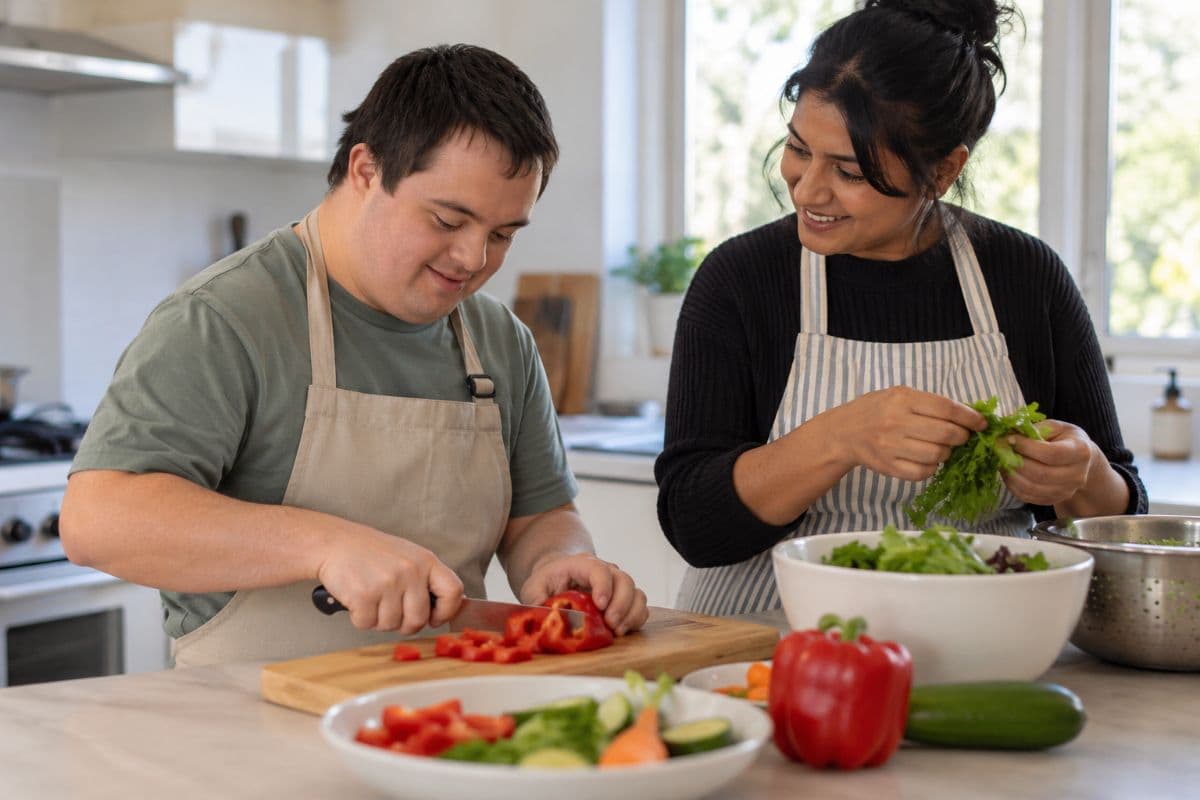
A cooking skills support worker in Sydney can help a person practise everyday kitchen tasks, from planning a meal to preparing ingredients and following a simple recipe. The aim is to support participation and build confidence at a pace that suits the person. This is different from meal preparation, where the main focus may be getting food ready. At Valencea, cooking-related support can be discussed through Life Skills Development and Meal Preparation. Whether an activity can be funded depends on the participant's plan and the current NDIS rules.
Mag-book ng Libreng Konsultasyon
Key takeaways
Here are the main points in this article.
- Cooking skills support is about doing tasks with a person, not automatically doing everything for them.
- Meal preparation and cooking skills development can have different purposes, even in the same kitchen.
- Good goals are practical, personal and based on what someone wants to do.
- Kitchen safety, communication, preferences and the level of help needed should be discussed before support begins.
- Valencea works with self-managed and plan-managed participants, with a minimum two-hour shift.
What does a cooking skills support worker do?
Cooking involves more than turning on the stove. Someone may want help deciding what to eat, reading a recipe, organising ingredients, using kitchen equipment or cleaning up afterwards. A support worker can help the person take part in these activities in line with their preferences and abilities.
For example, one person may want to practise making a sandwich on their own. Another may enjoy making dinner but need help organising the steps. Someone else may want to learn how to shop for ingredients and cook a simple meal at home.
The starting point should be a conversation about what matters to the individual. A helpful question is: which parts of cooking would you like to do yourself, and where would you like help? Valencea's Life Skills Development service is a starting point for talking about these goals.
Cooking skills support and meal preparation: what is the difference?
These activities can look similar, but the purpose is often different.
With cooking skills support, the focus is on practising everyday skills. The person takes part in the tasks they choose, may learn to follow a recipe, and progress is measured against their own goals. With meal preparation support, the focus is on getting food ready. A worker may complete more of the tasks, and finishing the meal may be the main priority. How much the person takes part depends on their needs.
Consider two examples. In the first, a worker prepares lunch because the participant needs help getting a meal ready. In the second, the participant wants to learn to make that lunch. The worker talks through the steps, helps organise the ingredients and supports the participant to practise. Both involve food, but the goals differ.
Neither approach is automatically better. The right one depends on the person's needs, choices and support arrangements. Valencea also offers Meal Preparation for people who want practical help with meals.
Five ways to build kitchen confidence
1. Start with a familiar meal. The person might choose breakfast, a sandwich, a salad or another simple dish they enjoy. The aim is not a perfect meal. It is to find tasks that feel useful and achievable, and to agree which ones the person wants to try.
2. Break the activity into smaller steps. Cooking involves many decisions at once: gathering equipment, preparing ingredients, following instructions, checking the food and cleaning up. Shorter steps can make it easier to follow. Some people prefer spoken instructions. Others find a written list, pictures or a demonstration more useful. The person should have a say in how instructions are given.
3. Practise using kitchen equipment safely. Confidence in the kitchen includes knowing when to ask for help. Before starting, the person and worker should talk about the equipment involved, any risks and what help is needed. For some people, simple tools are a good starting point. Other activities may need closer help, or may not suit the person's needs. The type of activity should always suit the support arrangement and the worker's skills.
4. Connect shopping with cooking. Cooking often starts before you enter the kitchen. A person may want to practise choosing a recipe, checking what is already at home, writing a shopping list or working out which ingredients to buy. Valencea's Shopping Assistance service may be relevant when you talk about support across these connected activities.
5. Review what felt easier and what still needs help. Progress does not have to mean cooking a whole recipe alone. Someone may feel more comfortable choosing ingredients, following one step or asking for help when needed. A short chat after cooking can help. What did you enjoy? Which step felt easier? Was anything confusing? What would you like to try next time? There should be room to change the activity or goal, because the person's preferences matter more than a fixed timetable.
How to talk about cooking goals with a support worker
A useful cooking goal describes something meaningful to the person. Instead of just saying, "I want to improve my cooking," try something more specific, such as "I want to practise making my own breakfast with the amount of help I need." Other goals might be following a short recipe, preparing ingredients, planning a shopping list or helping to make a family meal. These are examples to talk about, not goals everyone should adopt.
Before arranging support, talk about what the person likes to eat, which kitchen tasks they already do and what help they prefer. It also helps to discuss any equipment, communication preferences or safety points that may affect the activity.
At Valencea, support workers are matched to the person's preferences. A free, no-obligation Meet and Greet is a chance to talk about what support could look like.
Can NDIS funding be used for cooking skills support?
Cooking-related help may sometimes be considered alongside everyday living supports or skill-building supports. But an activity is not automatically funded just because a support worker is involved. The right support item and funding arrangement depend on the activity, its purpose, your plan and the current NDIS rules.
If your plan is plan-managed, the relevant price limits and claiming rules need to be checked. Self-managed arrangements have different pricing considerations. Check the current NDIS Pricing Arrangements and Price Limits, and ask your planner or support coordinator how this applies to you.
Before booking, ask which support item is proposed, what the service involves and how it will be invoiced. Valencea offers a free, plain-language chat about what a plan can be used for. This is general information, not financial or legal advice.
What should you ask before arranging cooking support?
A short conversation can help you see whether the arrangement suits the person. Ask what the worker will do, which activities the participant can practise and what help will be available. Talk about food preferences, kitchen routines, communication needs and the level of support required. It is also useful to be clear whether the main goal is meal preparation, skill development or both.
If the person has specific safety or health needs, explain these before agreeing to support. You can read about Assistance with Daily Life to see the broader context of everyday support.
Cooking support in Western Sydney: local proof
Valencea is a small, founder-led support provider based in Northmead. Its co-founders are Arash Hasanzadeh and Sunny Ria, and both speak English and Persian. Valencea provides one-to-one support and offers a free Meet and Greet with no obligation.
Its location pages cover Northmead, Parramatta, Blacktown, Castle Hill, Carlingford, Epping, Ryde, Chatswood, Toongabbie and North Rocks. For people looking for help with home routines and cooking, the Western Sydney page is a local starting point.
It works with self-managed and plan-managed participants. The minimum shift is two hours, and suitability and availability should be discussed before booking.
Talk to Valencea about your cooking goals
Whether you want to practise a simple recipe, organise your meals or feel more comfortable taking part in kitchen tasks, you can start with a free conversation. You can call or WhatsApp Valencea on 0494 798 710, email hello@valencea.com.au, or use the Request Support form. Contact hours are Monday to Sunday, 7:00am to 8:00pm, and Valencea is available 24/7 for existing participants. You can also book a free consultation on the website.
This article gives general information only. NDIS funding and support suitability depend on individual circumstances. Speak with your planner or support coordinator about your own plan.
FAQ
Can a support worker teach me how to cook?
A support worker can help you practise everyday cooking tasks, such as preparing ingredients, following simple steps and organising a meal. This is practical support, not professional cooking instruction or therapy. At Valencea, you can talk about cooking goals through Life Skills Development and Meal Preparation. Activities should suit your preferences, your needs and the worker's skills.
What is the difference between cooking skills support and meal preparation?
Cooking skills support focuses on helping you take part in and practise tasks you want to learn. Meal preparation focuses more on getting food ready. Both may involve similar activities, but the purpose and level of participation can differ. You can talk about which suits you at Valencea's free Meet and Greet.
Can I use my NDIS plan for cooking lessons?
Funding depends on the purpose of the activity, the support item, your plan and the current rules. Practical skill-building with a support worker is not necessarily the same as a formal cooking course. Ask your planner or support coordinator about your funding, and confirm the proposed support before you book.
Can cooking support include help with shopping?
Cooking and shopping can be connected. You may want help choosing ingredients, making a shopping list or preparing food after shopping. Valencea offers Shopping Assistance as well as Meal Preparation and Life Skills Development. Talk through the activities you need, so the proposed support can be matched to your goals and plan.
Do I need to know how to cook before starting?
No. You do not need any cooking experience to talk with Valencea about your goals. You might want to practise a familiar task, try a simple meal or talk about what feels difficult in the kitchen. The starting point is your preferences, the help you need and whether the activities suit you.
Does Valencea work with self-managed and plan-managed participants?
Yes. Valencea works with self-managed and plan-managed participants. If you are unsure how your plan is managed, check your plan or ask your planner or support coordinator.
Can I choose a support worker who suits my preferences?
Valencea matches support workers to participants' preferences. At the free Meet and Greet, you can talk about your communication style, preferred activities and what helps you feel comfortable.
How do I start cooking skills support with Valencea?
You can phone or WhatsApp Valencea on 0494 798 710, or use the Request Support form. Explain which cooking tasks you want help with and whether your plan is self-managed or plan-managed. Valencea offers a free Meet and Greet with no obligation. Support is one-to-one, with a minimum two-hour shift.
Handa nang pag-usapan ito?
Makipag-ugnayan sa amin at tutulungan ka ng aming team na alamin kung ano talaga ang posible para sa iyong plan.
Humiling ng SuportaKaugnay na serbisyo
Tungkol sa Valencea
Tao Muna. Palagi.
Ang Valencea ay isang tagapagbigay ng suportang NDIS na itinayo sa simpleng paniniwala: karapat-dapat ang bawat tao na mamuhay nang may kalayaan sa pagpili, dignidad, at koneksyon. Nagtutulungan ang aming team kasama ang mga participant, pamilya, at tagapag-alaga upang maghatid ng suportang akma sa totoong buhay — hindi sa kabaligtaran.
Mag-book ng Libreng Konsultasyon
