
Autism and the NDIS
Autism NDIS support in Sydney: a practical guide for families
If you are an autistic adult, or a parent or carer looking into autism NDIS support for the first time, the hardest part is usually not the paperwork. It is working out what the scheme actually does, what it does not do, and what everyday life looks like once a plan is in place. This guide is written in plain Australian English for participants, families, carers and nominees across Sydney and Western Sydney.
We use identity-first language throughout — autistic person, autistic participant — because that is what most of the Australian autistic community prefers. Autistic people have very different strengths, needs and preferences, and support should reflect the individual rather than a diagnosis label.
It is general information, not an eligibility decision. Rules and pricing change, so confirm current information with the National Disability Insurance Agency (NDIA), a my NDIS contact or a plan manager.
Book a Free Consultation
Quick answer
An autism diagnosis does not create identical NDIS entitlements for everyone, and it does not guarantee access. The NDIA assesses the access criteria and the supporting evidence, and funding decisions depend on disability-related functional needs and the wording of the approved plan. NDIS funding is not a general entitlement to every service: a support generally must be an NDIS support, relate to disability, and fit the participant's plan.
In practice that means describing communication, learning, social interaction, self-care, self-regulation, sensory environments, safety and everyday participation in concrete terms. Families of children under nine can also ask about the early childhood approach.
- A diagnosis can be important evidence, but it is not the whole application.
- Access depends on the applicable criteria and individual circumstances, assessed by the NDIA.
- Funded supports must be disability-related and consistent with current NDIS rules and the plan.
- Everyday supports — daily living, household tasks, community participation, transport — are a practical part of many plans.
- Two people with the same diagnosis may have very different support arrangements. That is normal.
Does an autism diagnosis mean you get the NDIS?
No. This is the most common misunderstanding about autism NDIS support, and it is worth being blunt about. A diagnosis can be important evidence, but access and funding decisions also depend on the applicable access criteria and on the person's disability-related functional impacts. The NDIA makes that decision; no provider, website or support worker can make it for them.
Eligibility is about the criteria, not a blanket promise, and an assessment is individual. Start with the participant's own goals and the wording in their current plan, and treat another family's plan as a story rather than a prediction of your own. If anything is unclear, confirm it with the NDIA or your plan manager rather than relying on general online advice — including this page.
How to describe support needs beyond the diagnosis
Useful evidence explains what happens on ordinary days. Instead of writing only that a child 'struggles with routines', explain what happens before school, during transitions, while travelling, or at family activities, and include what assistance is required, how often, and what occurs without it.
Describe strengths as well as barriers — describe support needs, not deficiencies in the person. Where possible include the person's own words and preferences. For an adult participant that is the starting point; for a child it should be gathered in an age-appropriate way.
- Communication: how the person communicates, what helps, and in which settings.
- Daily living and self-care: morning and evening routines, meals, personal care, household tasks.
- Learning and participation: school, study, work, groups and activities.
- Self-regulation: what support looks like before, during and after a difficult moment.
- Sensory environments: noise, light, crowds, texture, temperature, and what helps.
- Safety: specific situations, settings and frequency.
- Strengths and preferences: what the person is good at, enjoys and wants more of.
Early childhood: what families of children under nine can ask about
The NDIA early childhood approach is designed to help children younger than nine who have a developmental delay or disability connect with relevant supports. Early connections may be available even where a child is not an NDIS participant, and for children under six with developmental concerns, early help does not necessarily require a formal diagnosis.
Pathways and children's supports depend on age and circumstances, and they change over time. Verify the current early childhood pathway directly with the NDIS rather than relying on a summary. Families can also access mainstream, community and school-based help — the scheme does not replace education, health or other service systems.
Setting strengths-based goals that respect the person
Goals work better when they describe something the person actually wants: feeling comfortable using public transport, making choices about outings, learning a routine they want to own, cooking a meal independently, or connecting with a preferred community activity.
Progress should not be judged by forcing typical behaviour or removing harmless autistic traits. A good goal expands what the person can choose to do; it does not make them look less autistic.
Good arrangements are reviewed rather than left on autopilot. Compare the participant's preferences and outcomes against the services actually scheduled, then adjust with consent. If needs or the plan change materially, speak to the appropriate NDIS contact rather than assuming a provider can claim more funding.
Everyday support at home and in the community
This is the part of autism NDIS support that most affects daily life, and the part people tend to under-specify. Consider how the support is actually delivered rather than just its name: specify the tasks, frequency, duration, preferred communication method, accessibility needs, location, and what the participant would like to do independently. A clear roster avoids misunderstanding and helps the participant keep choice and control.
A practical Sydney illustration: a participant in Northmead might want a predictable morning household routine, accessible travel to Parramatta, and assistance to join a community activity. Those are three different tasks with three different objectives — record the objectives, hours and eligible charges separately rather than describing every cost as generic 'NDIS support'. This is illustrative, not a guarantee of funding.
- Assistance with daily life: routines, meal preparation, organising the day.
- Household and domestic tasks: cleaning, laundry, keeping a space workable.
- Personal care, where that is part of the person's support needs.
- Community participation: getting to and taking part in chosen activities.
- Transport assistance: travel to appointments and the places that matter.
- Companionship and social or recreational activities, where disability-related and in the plan.
Working with a support worker: predictable, sensory-aware routines
Predictability is often the practical difference between an activity being possible and being overwhelming. Some people prefer visual plans, advance notice of changes, quieter environments, a consistent worker, a particular time of day, or a different communication method. Ask first rather than assume: preferences vary enormously, and the same person may need something different on different days.
Most problems with everyday support come from things that were never discussed, so agree on sensory preferences, communication methods and the shape of the shift before the first visit. A support worker should follow the participant's preferences, and families can discuss worker suitability and service agreement terms if the fit is not right.
- Advance notice of changes, and a named person who tells you when something changes.
- A written or visual plan for the shift, shared beforehand.
- Worker continuity, with an agreed approach when the usual worker is away.
- Agreed sensory adjustments: noise, lighting, crowd levels, route choice, break points.
- An agreed communication method, including non-speaking and alternative communication.
- A clear way for the participant to say 'stop' or 'not today' and have it respected.
- A record of what was provided, by whom, when and for how long.
- A short review conversation after the first few shifts.
Support across childhood, the teenage years and adulthood
Support needs change with age, and so does who holds the decision-making. For younger children, planning typically involves the family closely and should still involve the child in age-appropriate ways. For teenagers, the shift toward the young person's own voice, privacy and choices matters more than the roster.
For adult autistic participants, daily living support is available when they meet access and funding requirements and the support fits their plan — commonly help with transport, unfamiliar appointments, household routines and community activities. These are illustrations rather than entitlements; the service should be matched to the plan and documented before claims are made.
School, health and mainstream supports: who pays for what?
The NDIS is one part of a broader support system. Schools, health services, community groups and NDIS-funded supports have different responsibilities, and school and NDIS responsibilities in particular are often confused — check funding arrangements before assuming support can be delivered at school.
Education, healthcare and ordinary parental responsibilities are not simply transferred to the NDIS. Clarify who provides which support rather than expecting one funding source to pay for everything. If a child is not eligible, ask about early childhood connections, community, education and mainstream services that may still help.
What does autism NDIS support cost?
There is no single answer, and you should be sceptical of any page that gives you one. Rates for funded supports are set by the current NDIS Pricing Arrangements and Price Limits, which vary by support item, time of day and day of week — check the current document rather than a figure quoted in an article, including this one.
Before booking or spending, request a written explanation identifying the exact support, the rate or funding category, the planned outcomes and any exclusions. Do not rely on screenshots, social media lists of 'free NDIS items' or a provider's sales claim as proof that an expense is eligible — the official NDIS supports lists distinguish eligible disability supports from ordinary living expenses and from costs other systems should fund. Where a provider and the NDIA differ, the official guidance and your own plan are what count.
- Request the support item description and any price or claim conditions in writing.
- Confirm the current funding period and the available balance in the relevant budget.
- Confirm any restriction or provider registration requirement that applies to the support.
- Ask how travel, cancellation and minimum shift lengths are charged, and whether those charges are valid for your funding management type.
- Ask how consent, personal information and complaints are managed.
Questions to ask a Sydney provider before you commit
Give every provider the same information so you are comparing like with like, and write down the outcomes you want before the first enquiry — it changes the conversation completely.
- What exact disability-related outcome will this support address, and which tasks are excluded?
- Which NDIS support item or category is proposed, and why?
- Is my plan and funding management type compatible with how you work?
- How will you adapt to communication, sensory, cultural and accessibility preferences?
- Which worker will attend, and what happens if they are away?
- What are your full rates, travel charges, minimum shift and cancellation conditions?
- How do you manage feedback, incidents, safeguarding, complaints and privacy, and what training and supervision do your workers receive?
- What happens if an arrangement becomes distressing or unsuitable, or if my needs, plan or preferences change?
- Who records outcomes, and how can I review or end the arrangement?
A step-by-step checklist you can work through this week
Use this in a real conversation rather than as a form to fill in. It works for a first plan and for a review, and it is a reasonable order of operations if you want something concrete to do this week.
- Day 1: Start with the participant's own priorities, in their own words, and name the specific disability-related barrier and the outcome you want to change.
- Day 2: Read the current plan, identify the relevant budget and its available balance, and compare it against the most recent official rules and supports lists.
- Day 3: List the tasks, desired outcomes, preferred times and accessibility needs, and ask providers for a written service description, support item numbers where applicable, and a full pricing breakdown.
- Day 4: Compare worker fit, safeguarding, travel, cancellation terms and how changes are managed, then confirm service, frequency, rate and payment conditions in writing.
- Day 5: Agree communication, sensory and consent arrangements, arrange a modest initial schedule, and set a review date.
- After delivery: keep evidence of what was provided and review the arrangement with the participant.
Common mistakes to avoid
Almost all of these are avoidable with one written question asked before money is spent.
- Assuming an autism diagnosis automatically guarantees access or a particular budget.
- Treating every advertised disability service as automatically NDIS-funded.
- Using outdated prices instead of the current official document.
- Booking before checking the written service agreement.
- Confusing ordinary living expenses with disability-specific supports, or assuming one participant's plan predicts another's.
- Expecting the NDIS to cover what education, health or other systems are responsible for.
- Disclosing sensitive medical or plan information before you understand how it will be handled.
- Accepting approaches that promise a cure, or that erase the person's preferences and autonomy.
- Leaving an arrangement on autopilot instead of reviewing it with the participant.
A realistic example (fictional composite)
Imagine an autistic participant in Western Sydney whose goal is joining a community activity they have chosen. They describe the sensory conditions that make it workable, compare two options, check the plan and the written costs, agree communication preferences and a consistent worker, then trial the arrangement for several weeks. At the review they look at whether the support improved choice, participation and everyday functioning — not whether the person behaved more typically. This scenario is illustrative: it is not a guarantee of approval, funding or outcomes.
How Valencea may be able to help in Western Sydney
Valencea is based in Northmead, NSW, and serves Western Sydney along with its other advertised Sydney service locations, including Parramatta, Blacktown and surrounding suburbs. We support both self-managed and plan-managed participants.
We provide everyday assistance and assistance with daily life, personal care, household and domestic tasks, community participation and transport.
To talk through the everyday support you are looking for, current availability, funding management compatibility and a written proposal, call 0494 798 710, email hello@valencea.com.au, or visit valencea.com.au.
Official Australian sources
These are the official pages our sources cite. Check them directly, because NDIA guidance, legislation and pricing schedules change.
- NDIS — Guide to the early childhood approach (ndis.gov.au/applying/children/guide-early-childhood-approach)
- NDIS — How to check your eligibility (ndis.gov.au/applying/eligibility-requirements/how-check-your-eligibility)
- NDIS — What are NDIS supports? (ndis.gov.au/participants/using-your-funding/understanding-your-ndis-funding/what-are-ndis-supports)
- NDIS — Guide to using your funding (ndis.gov.au/participants/using-your-funding/understanding-your-ndis-funding/guide-using-your-funding)
- NDIS — What are NDIS support budgets? (ndis.gov.au/participants/using-your-funding/ndis-support-budgets/what-are-ndis-support-budgets)
- NDIS — What are core supports? (ndis.gov.au/participants/using-your-funding/different-budget-types/what-are-core-supports)
- NDIS — What is a support worker? (ndis.gov.au/participants/working-providers/support-workers-and-recovery-coaches/what-support-worker)
- NDIS — A new way of planning (ndis.gov.au/changes-ndis/new-way-planning)
- NDIS — Pricing Arrangements and Price Limits, for current rates (ndis.gov.au)
About this guide
This article is general information only. It is not an eligibility decision, and it is not personalised funding, legal, financial or clinical advice. It does not replace advice from the NDIA, a my NDIS contact, a plan manager or your own advisers, or the details written in an individual NDIS plan. NDIA guidance, legislation, pricing schedules and plan arrangements can change — confirm current pricing, support rules and your own plan before making a claim or a commitment. This guide was last reviewed on 18 October 2026.
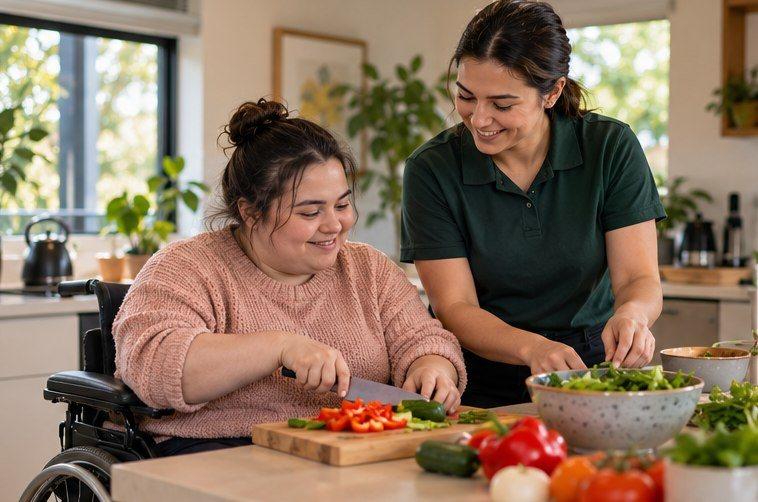
Photo disclosure: the image on this page is an illustrative stock or AI-generated image. It does not show a real Valencea participant or support worker, and it does not depict autism — it shows a person who uses a wheelchair being supported at home, included to illustrate everyday support in an Australian home rather than the topic of this article.
FAQ
Does an autism diagnosis guarantee NDIS access or funding?
No. A diagnosis can be important evidence, but access depends on the applicable NDIS access criteria and the person's individual circumstances, including disability-related functional impacts. The NDIA assesses the criteria and the evidence and makes the decision. No provider can approve access or promise funding.
Does every autistic child qualify for the NDIS?
No. Access depends on the applicable eligibility and early intervention criteria rather than on diagnosis alone, and decisions are individual. If a child is found not to be eligible, ask about early childhood connections, community, education and mainstream services that may still help.
Is a diagnosis alone enough evidence for an access request?
Not necessarily. Functional impact and the relevant access criteria both matter. Useful evidence explains communication, daily living, participation, learning, self-regulation, sensory environments and safety in specific settings, including what assistance is needed, how often, and what happens without it.
Can children under nine get NDIS-related assistance?
Yes, the NDIA early childhood approach offers pathways and connections for children younger than nine with developmental delay or disability, and some early connections may be available without NDIS participant status. For children younger than six with developmental concerns, early help does not necessarily require a formal diagnosis. Verify the current pathway with the NDIS.
Can an adult autistic person use daily living support?
Yes, when they meet the access and funding requirements and the support fits their plan. Common requests include help with household routines, meal preparation, navigating transport, attending unfamiliar appointments and joining community activities.
Can the NDIS fund community participation?
Possibly, where the support is disability-related, aligned with the participant's plan and covered under the current NDIS support rules. Check the official NDIS supports information and your own plan before booking or claiming.
Can NDIS support be delivered at school?
School and NDIS responsibilities differ, and funding arrangements must be checked before making assumptions. The NDIS does not replace the education system. Clarify with the school and the NDIA who is responsible for which support.
Should a support worker follow the autistic person's own preferences?
Yes. Respect, consent, communication preferences and individual needs should guide every support arrangement. Agree on sensory preferences, communication methods and the shape of the shift before the first visit, and review how it went with the participant.
Can families ask for a different support worker?
Families and participants can discuss worker suitability, continuity and the terms of the service agreement with the provider. Ask up front which worker will attend and what happens when that person is away.
How much does an autism-related NDIS support worker cost?
Rates for funded supports are set by the current NDIS Pricing Arrangements and Price Limits, which vary by support item, time of day and day of week — check the current document rather than a figure quoted online. Also ask the provider in writing about travel, minimum shift and cancellation charges, and whether they are valid for your funding management type.
Ready to talk it through?
Get in touch and our team will help you work out what's genuinely possible for your plan.
Request SupportRelated services
About Valencea
People First. Always.
Valencea is an NDIS support provider built on a simple belief: every person deserves to live a life of choice, dignity and connection. Our team works alongside participants, families and carers to deliver support that fits real lives — not the other way around.
Book a Free Consultation
