
Support Worker Training and Safety
First Aid and CPR for NDIS Support Workers
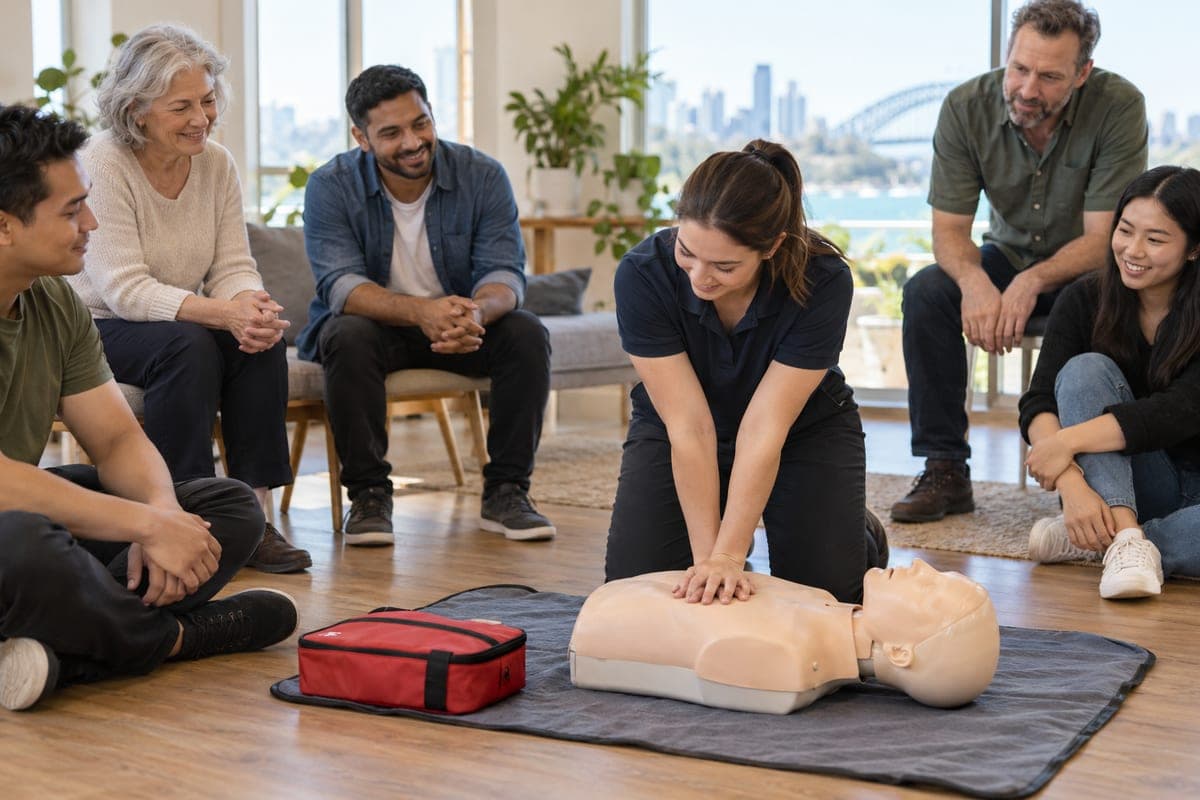
First aid and CPR are valuable safety skills, but there is no single blanket NDIS rule stating that every support worker in every role must hold the same certificate. Requirements can depend on the provider, workplace, duties, participant risks and other laws or policies. Ask whether the proposed worker's training is current, who issued it, what it covered and how emergencies related to your support needs are planned.
Book a Free Consultation
Quick answer
There is no single NDIS-wide rule requiring every support worker, in every role, to hold the same first aid and CPR certificate. What is required is that training and emergency-response capability match the worker's actual duties, the participant's needs, applicable work health and safety requirements, and the relevant NDIS Practice Standards.
In New South Wales, SafeWork NSW guidance for workplace first aiders recommends CPR refresher training every year and first aid renewal every three years. That is guidance for workplace first aiders, not an automatic expiry date stamped on every nationally recognised unit — which is why it is worth asking a provider how they actually assess a worker's current emergency-response competence.
At a glance: what is required and what is recommended
The points below are the short version of the rest of this guide. Each one is expanded in the sections that follow.
- Is first aid mandatory for every NDIS worker? Not as a universal, identical certificate rule for every job. It depends on the support, the risks, the provider's duties and other applicable requirements.
- How often should CPR be refreshed? SafeWork NSW recommends annual CPR refreshers for workplace first aiders.
- How often should first aid be renewed? SafeWork NSW recommends renewal every three years for workplace first aiders.
- Does a certificate authorise clinical tasks? No. High-intensity and clinical tasks need role-specific competence and separate safeguards.
Why the actual role matters
A worker providing community access, transport or personal care may face different foreseeable risks from a worker helping with a low-risk household task. The provider should assess what preparation is appropriate for the agreed work.
Safety is more than a certificate. It also depends on respectful behaviour, clear boundaries, accurate records, following agreed instructions and speaking up when a task is outside the worker's competence or role. Participants should be involved in decisions and should know how to raise a concern without fear of losing support. Look for evidence that safety is part of ordinary practice: the worker asks before acting, explains unfamiliar steps, protects private information and reports changes promptly. A person should never be pressured to accept a task, worker or arrangement simply because it is easier for the roster. Immediate danger should be handled through emergency services, not a routine feedback channel.
Are first aid and CPR compulsory under the NDIS Practice Standards?
The NDIS Practice Standards focus on whether supports are safe, responsive and delivered by competent workers. They require suitable systems for managing risks and responding to participant emergencies, in the settings and registration modules to which they apply. They do not create one simple certificate rule that applies identically to every NDIS support worker.
For registered providers subject to the relevant standards, participant-specific medical emergency protocols and trained worker responses matter particularly. Separately, work health and safety duties, employer policies, insurance requirements and the nature of a particular shift may each lead a provider to require first aid and CPR credentials.
A worker providing light household assistance faces different foreseeable risks from someone supporting personal care, community outings, or a participant with a known seizure or choking risk. Training should be matched to the work and the person — not selected by job title alone.
What do HLTAID009, HLTAID010 and HLTAID011 mean?
These are nationally recognised unit codes from the Australian training system. Asking for the exact code and the date of issue on a worker's Statement of Attainment is far more useful than accepting the phrase “first aid trained”.
A qualification or unit of competency does not necessarily expire automatically after twelve months or three years. Those intervals describe commonly recommended refresher practice; employers and roles may impose their own currency requirements on top.
- HLTAID009 — Provide cardiopulmonary resuscitation. The dedicated CPR unit. This is the code to look for when asking about current CPR training.
- HLTAID010 — Provide basic emergency life support. Covers basic emergency life support knowledge and skills.
- HLTAID011 — Provide First Aid. The broader first aid unit, covering a range of emergencies and incorporating CPR-related competencies.
- Any of these codes can be checked on the Australian Government training register at training.gov.au.
How often should first aid and CPR be renewed in NSW?
According to SafeWork NSW guidance for workplace first aiders, CPR refresher training should be undertaken annually and first aid qualifications renewed every three years. Some roles require more frequent or more specialised updates.
Check the training provider's record, the applicable employer policy and the participant's risk profile rather than relying only on a date printed on a badge. If a worker completed first aid two years ago but has not refreshed CPR recently, ask the provider how they assess current emergency-response competence. That is a much better conversation to have before support begins than during a crisis.
What to verify before support begins
Do not rely on the phrase fully trained. Ask for the type of course, completion or expiry information, and whether practical assessment was included.
Ask for plain answers rather than broad assurances. A provider should be able to explain which checks or training are relevant to the actual duties, how current information is verified, what happens when a worker needs guidance and who you contact if something goes wrong. Keep copies of agreed support information where practical. Distinguish a legal requirement from a provider policy and from a good-practice preference; they are not always the same. Ask whether information relates to the proposed worker or is only a general company statement. If circumstances change, pause and reassess the task instead of assuming an earlier agreement automatically covers new risks or responsibilities.
- Current first aid status where relevant
- Current CPR status where relevant
- Emergency contacts and escalation steps
- Participant-specific emergency information
Certificates are only one part of readiness
In an emergency, a worker also needs access to accurate information, a way to call for help and a clear understanding of their role. They should not attempt procedures beyond their competence.
Safety is more than a certificate. It also depends on respectful behaviour, clear boundaries, accurate records, following agreed instructions and speaking up when a task is outside the worker's competence or role. Participants should be involved in decisions and should know how to raise a concern without fear of losing support. Look for evidence that safety is part of ordinary practice: the worker asks before acting, explains unfamiliar steps, protects private information and reports changes promptly. A person should never be pressured to accept a task, worker or arrangement simply because it is easier for the roster. Immediate danger should be handled through emergency services, not a routine feedback channel.
What should a support worker know in an emergency?
The right preparation is participant-specific. A worker should understand their responsibilities, know how to summon emergency help, and follow an agreed, accessible plan. In practice that means knowing:
In an immediate life-threatening emergency in Australia, call Triple Zero (000). This article is general information and is not a substitute for first aid instruction or a participant-specific clinical emergency plan.
- Where to find emergency contacts, relevant care instructions and accurate medication information, where they are authorised to access it.
- How the participant communicates pain, distress or a change in health status.
- What to do about known allergies, seizure risks, swallowing difficulties, mobility barriers or other documented risks.
- Who to contact after calling emergency services, and what information can be shared with consent or another lawful basis.
- When to stop a task, seek professional advice or escalate an urgent concern.
Plan for foreseeable emergencies
Discuss allergies, communication needs, mobility, known risks, emergency contacts and what information may be shared with responders. Clinical emergency planning should involve the appropriate health professional.
Ask for plain answers rather than broad assurances. A provider should be able to explain which checks or training are relevant to the actual duties, how current information is verified, what happens when a worker needs guidance and who you contact if something goes wrong. Keep copies of agreed support information where practical. Distinguish a legal requirement from a provider policy and from a good-practice preference; they are not always the same. Ask whether information relates to the proposed worker or is only a general company statement. If circumstances change, pause and reassess the task instead of assuming an earlier agreement automatically covers new risks or responsibilities.
A practical example: support in the community
Imagine a participant and support worker planning a trip to a local shopping centre in Western Sydney. The worker holds a first aid certificate, but the participant uses a communication aid and sometimes experiences dizziness.
Before leaving, they discuss accessible routes, how the participant signals discomfort, emergency contacts, the nearest safe place to stop, and what the worker should do if the person becomes unwell.
The certificate is useful. The shared plan is what makes it relevant. That is the difference between collecting certificates and actually preparing for support.
Seven questions to ask before choosing a support worker
Take these to a meet and greet rather than relying on a general claim such as “fully qualified”:
- Which first aid and CPR units has this specific worker completed, and when?
- Who issued the Statement of Attainment — was it a Registered Training Organisation (RTO)?
- How does the provider decide what training is necessary for my support?
- Has the worker read and understood my current emergency and communication plan?
- What happens if the worker encounters a task beyond their training or agreed role?
- Who should I contact if my support needs change, or if an incident occurs?
- Can we discuss all of this in a meet and greet before agreeing to support?
First aid is not the same as high-intensity or nursing support
General first aid preparation does not authorise a worker to perform nursing duties or complex procedures. Additional competencies, documented plans, supervision or health practitioner involvement may be required for particular high-intensity supports. The NDIS Quality and Safeguards Commission publishes separate high-intensity support skills descriptors for the relevant activities.
Before agreeing to any complex support, ask whether the service is within the provider's current scope, whether the worker has the relevant training, and whether the required safeguards are in place. Do not assume a first aid certificate answers any of those questions.
What families in Sydney can do today
If you are comparing NDIS support workers in Northmead, Parramatta, Blacktown or elsewhere in Sydney, use a short written checklist rather than relying on broad assurances. Five minutes spent recording your emergency contacts, communication preferences, known risks and the questions you want answered will make every provider conversation more useful.
Share only the information necessary for safe support, and share it through an appropriate channel — not an unrelated third-party website or an open social media message.
- Worker's first aid and CPR unit codes checked
- Training currency discussed
- Emergency contacts confirmed
- Participant-specific plan reviewed
- Escalation process explained
- Role and boundaries agreed
Talk with Valencea
If you are comparing support workers, contact Valencea with the tasks, risks and questions that matter to you. We will not treat a certificate or broad promise as a substitute for a clear conversation about scope and fit. Valencea is based in Northmead and supports plan-managed and self-managed participants across Western Sydney. Enquiries receive a response in under 2 hours, and support typically starts within 2–5 business days when needs, availability and fit are confirmed. Call 0494 798 710 Monday to Sunday, 7:00am–8:00pm, or make a low-pressure Request Support enquiry. You can also use the free meet and greet to ask worker-specific questions before making any commitment. Bring a short list so the matters important to your safety and comfort are not lost in a general conversation.
Official Australian sources and further reading
Every claim in this guide can be checked against a primary source. Requirements change, so verify anything that matters to your situation directly:
- NDIS Quality and Safeguards Commission — NDIS Practice Standards (ndiscommission.gov.au)
- NDIS Commission — Core module: provision of supports environment
- NDIS Commission — Verification module
- NDIS Commission — High intensity support skills descriptors
- SafeWork NSW — First aid in the workplace (safework.nsw.gov.au)
- Australian Government training register (training.gov.au) — search HLTAID009, HLTAID010, HLTAID011
About this guide
This guide describes the regulatory framework and SafeWork NSW guidance available at the time of review. Requirements can differ by state, role, provider and participant. It is general information, not legal or clinical advice, and it does not replace accredited first aid instruction or a participant-specific emergency plan prepared with the appropriate health professional.
Confirm current service scope and suitability before making arrangements.
FAQ
Does every NDIS worker legally need first aid?
There is no single blanket NDIS requirement for every worker and every role. Ask what applies to the service, workplace and risks involved.
How often should CPR be renewed?
Course currency can depend on the certificate, provider policy and current guidance. Ask to see the actual expiry or renewal information rather than relying on a general statement.
Can first aid training replace clinical qualifications?
No. First aid is emergency-response preparation and does not make a worker a nurse or authorise clinical or high-intensity support.
Is HLTAID011 the same as HLTAID009?
No. HLTAID009 is the dedicated CPR unit; HLTAID011 is the broader Provide First Aid unit, which incorporates CPR-related competencies. Check the Statement of Attainment for the exact codes completed.
Can an NDIS participant ask to see evidence of a worker's training?
Yes. You can ask a provider to explain the relevant qualifications and the worker's readiness for your support. Providers may manage how they share staff records to protect privacy, but they should be able to answer your safety questions clearly.
Do support workers need different training for seizures or other individual risks?
Potentially. Participant-specific risk assessments, individual plans and the requirements of the support activity determine what extra preparation is appropriate. Complex supports may carry additional requirements.
Does a CPR unit automatically expire after 12 months?
Not automatically. SafeWork NSW recommends annual CPR refresher training for workplace first aiders, which is not the same as saying every nationally recognised CPR unit expires on its first anniversary. Employers and roles may set their own currency requirements.
Ready to talk it through?
Get in touch and our team will help you work out what's genuinely possible for your plan.
Request SupportRelated services
About Valencea
People First. Always.
Valencea is an NDIS support provider built on a simple belief: every person deserves to live a life of choice, dignity and connection. Our team works alongside participants, families and carers to deliver support that fits real lives — not the other way around.
Book a Free Consultation
