
Getting started with the NDIS
NDIS access request: a step-by-step guide
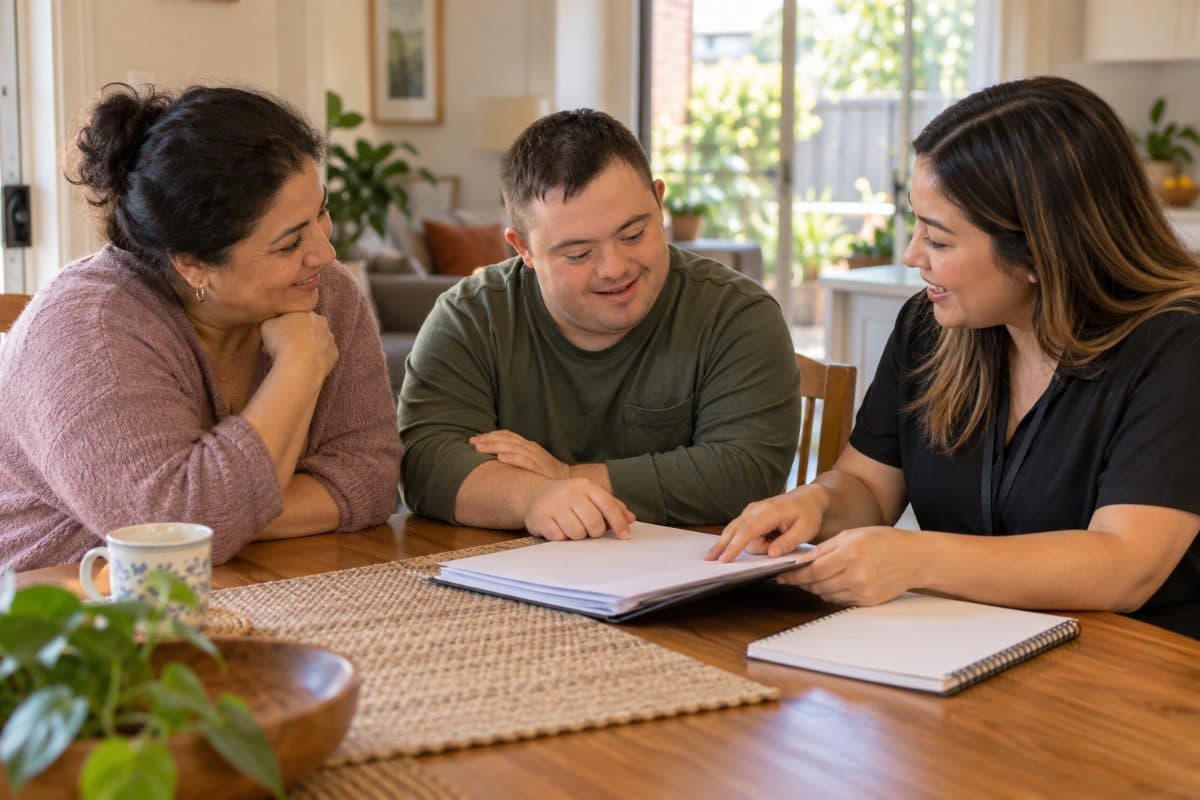
Applying for the NDIS begins with an access request, which requires evidence that a person has a permanent disability that significantly affects their ability to take part in everyday activities. This article covers the general shape of the process — exact forms, evidence requirements and timeframes are set by the NDIA and are worth confirming on ndis.gov.au before applying, since these details are periodically updated.
The process can feel bureaucratic and slow at a time when a family is often already stretched thin. Breaking it into clear steps can make it feel more manageable, even if the underlying paperwork itself doesn't change.
Book a Free Consultation
Quick answer
To apply for the NDIS: check the age and residency rules, speak with an NDIS partner, collect evidence about your impairment and how it affects everyday life, submit your application, and wait for the NDIA access decision. The Access Request Form is one route into the scheme — you do not always have to complete it yourself.
The NDIA currently states it will tell applicants whether they are eligible within 90 days after the application and all supporting evidence have been received. If you are not sure where to start, the NDIS contact number is 1800 800 110.
At a glance: what you need before applying
Getting a diagnosis does not by itself mean you qualify. The NDIA considers age, residency, and the disability and/or early intervention requirements together.
- Age — you must be younger than 65 when you first apply.
- Residency — you must live in Australia and be an Australian citizen, permanent resident, or holder of a Protected Special Category Visa.
- Disability or early intervention — you need to meet the disability requirements, the early intervention requirements, or both. A diagnosis alone does not guarantee access.
- Evidence — reports should explain the impairment, its likely permanence, the support needed, and how everyday activities are affected.
Step 1: Check basic eligibility
Broadly, the NDIS is available to Australian citizens, permanent residents, or holders of a Protected Special Category Visa, under a certain age at the time of applying, with a permanent disability that significantly affects everyday function. If you're unsure whether you meet these criteria, the NDIA's own eligibility checker or a call to the NDIA is the most reliable starting point.
Step 1b: Find the right NDIS partner
For applicants aged nine and over, a Local Area Coordinator (LAC) may guide the application. For children younger than nine, families are encouraged to contact an early childhood partner first — using the wrong pathway is one of the more common reasons an application stalls.
Partners can also discuss whether applying is the right step at all, and what community or mainstream supports exist in the meantime. You can find your nearest partner through the official NDIS office finder, or call the NDIA on 1800 800 110 if no partner is available. You are welcome to bring a family member, friend or other support person to any of these conversations.
Eligibility is decided by the NDIA — not by a GP, a support worker, or a disability service provider. Before paying for new assessments, ask an NDIS partner which evidence is actually relevant to your pathway.
Step 2: Gather evidence
The access request generally needs supporting evidence from a treating health professional, describing the diagnosis, how permanent the condition is, and how it affects daily functioning. Reports that are recent and specific about functional impact (not just diagnosis) tend to support a stronger application.
If you have several relevant professionals involved — a GP, a specialist, an allied health professional — it's often worth asking each one to contribute a short, specific statement about functional impact from their own area, rather than relying on a single generic letter.
The six functional areas the NDIA asks about
The access request form asks about six functional domains. A strong application tells the NDIA what the person cannot do reliably or safely without assistance, rather than listing diagnoses. Discuss concrete, everyday examples in each relevant area with your treating professional:
Useful evidence may come from a treating GP, medical specialist, psychologist, occupational therapist, physiotherapist, speech pathologist, psychiatrist or another appropriately qualified treating professional. The NDIS says evidence should be recent and prepared by an appropriate treating professional, and it generally recommends someone who has treated the person for at least six months.
- Mobility — transferring, walking, moving around the home, leaving the home, falls risk, accessing transport, or needing physical assistance.
- Communication — understanding instructions, expressing needs, communicating reliably, or using communication aids.
- Social interaction — participation with others, understanding social cues, and the support needed to interact safely.
- Learning — understanding, remembering and applying new information or skills.
- Self-care — showering, dressing, eating, personal hygiene and other personal care tasks.
- Self-management — planning routines, appointments, finances, decisions or medication routines.
Turning everyday challenges into useful evidence
Accuracy is more useful than dramatic wording. Instead of writing “needs help every day”, describe the specific task, how often support is needed, what happens without help, and whether the difficulty remains despite treatments or aids. Only include statements that are true and supported by the treating professional.
The following fictional examples illustrate the difference. They are not eligibility tests, and they are not wording to copy if they are not true for your situation.
A two-week activity diary helps. Before speaking with a clinician, write down real examples: the task, the level of help required, how long it took, any safety issues, and what happened when help was not available. The diary is a communication aid, not a substitute for clinical evidence — but it stops important details being forgotten in a short appointment.
- Instead of “I have trouble getting out”: “I require another person to help with transfers between my bed and wheelchair every morning and evening.”
- Instead of “communication is difficult”: “During appointments, I often need a support person to help me understand multi-step questions and explain my needs.”
- Instead of “I need help at home”: “I cannot complete showering independently and require physical assistance several times each week.”
Step 3: Submit the request
The access request can be submitted online, by phone, or with support from a Local Area Coordinator or NDIS-aware community organisation. Many families find it easier to get help from a Local Area Coordinator or a support organisation familiar with the paperwork, rather than doing it entirely alone.
- Confirm current eligibility criteria on ndis.gov.au before applying
- Gather evidence from a treating professional describing functional impact, not just diagnosis
- Consider asking a Local Area Coordinator or community organisation for help with the paperwork
- Keep a copy of everything submitted, and note the date it was lodged
Submitting the Access Request Form (ARF)
If you choose the ARF pathway, read the current form instructions rather than relying on an old copy saved on your computer. The form covers applicant details, consent, disability information and supporting professional evidence; a treating health professional typically completes the relevant clinical section, covering the primary impairment, functional capacity and existing assessments.
Current NDIA submission options include the NDIS service hub, post to NDIA, GPO Box 700, Canberra ACT 2601, or delivery to an NDIS partner or local office. Your partner may also submit the application on your behalf. Do not upload private medical information to unrelated third-party websites — use official NDIA channels.
- Check every page, declaration and signature before submitting.
- Attach the supporting reports and keep the original files.
- Record the submission date and any reference number.
- If asked for more evidence, confirm precisely what is missing before resending anything.
- Follow up with the NDIA directly when necessary.
Step 4: What happens after you apply
The NDIA reviews the application and evidence, and may ask for additional information before making a decision. If approved, the next step is generally an initial planning meeting to build the first plan. If declined, families have the right to request a review of the decision, and it's worth asking what additional evidence might strengthen that request.
How long does an access decision take?
The NDIA currently says it will tell you whether you are eligible within 90 days after it receives your application and all supporting evidence. Be careful with any single quoted timeframe: different NDIA information pages have described different decision periods, and the clock generally does not start before all required evidence has been received.
If the NDIA contacts you to clarify information or request further evidence, respond to the specific request rather than resending an unchanged bundle. Keep a simple communication log with dates, the items requested and the names of the people you spoke with.
An approval is an access decision. It does not automatically mean funding for every service you hope for — your eventual plan and its management arrangements determine what can actually be purchased.
If your application is declined
A decline does not mean you have no support options. Read the written reasons carefully and ask the NDIA to explain anything unclear.
You can generally request an internal review within three months of receiving the written decision. If you disagree with the internal review outcome, an external review through the Administrative Review Tribunal may be possible, generally within 28 days of that decision. An independent disability advocate can help you understand your options, and advocacy support is free.
Common reasons an access request stalls
Applications sometimes take longer than expected because the initial evidence doesn't clearly address permanence or functional impact, prompting the NDIA to request more information. This isn't necessarily a rejection in progress — it's often a normal part of the process, and responding promptly and specifically to whatever is requested tends to keep things moving.
It's also worth being cautious about assuming silence means a problem. Processing genuinely takes time, and following up with a polite check-in (referencing your application date) is reasonable if you haven't heard anything within the timeframe published on ndis.gov.au for your situation.
Common access request mistakes — and what to do instead
Most of the problems below are fixable before you submit, which is why they are worth reading twice:
- Diagnosis-only evidence — instead, ask professionals to explain the impairment, its permanence and its functional impact.
- Generic letters — instead, use specific, factual examples of daily activities and the support required.
- Missing signatures or consent — instead, check the current version of the form and every required declaration.
- Using the wrong childhood pathway — families of children under nine should usually start with an early childhood partner.
- Assuming a support provider determines eligibility — use the NDIA or an NDIS partner for official access information.
- Ignoring an adverse decision — read the reasons and act within the three-month internal review timeframe.
Two realistic application scenarios
Scenario A — an adult who needs daily living support. An adult with a long-term neurological impairment has a short specialist letter confirming a diagnosis, but nothing explaining how it affects dressing, meal preparation and community access. They ask the treating team for accurate functional assessments and practical examples of the assistance required, and the NDIA then assesses the full evidence against the access criteria.
Scenario B — a family concerned about a six-year-old. Parents notice substantial developmental and participation difficulties at home and at school. They contact an early childhood partner, gather existing developmental and health records, and discuss which of the early intervention and disability pathways applies. While eligibility is being considered, they also ask about community and mainstream supports.
Both are illustrations, not guarantees of approval.
A printable application checklist
Save or print this before you start. Working through it in order is usually faster than collecting documents as they are requested:
- I checked the age, residency and disability / early intervention criteria.
- I contacted the right NDIS partner — a LAC, or an early childhood partner for a child under nine.
- I collected identity and residency evidence and the relevant treatment history.
- I asked professionals to describe functional impact across the relevant domains, with real examples.
- I included existing assessments, allied health reports and treatment information.
- I reviewed consent, signatures and the current submission instructions.
- I saved the submitted application, the documents and the acknowledgement.
- I recorded follow-up dates and any requests for extra evidence.
NDIS application help in Western Sydney
Families in Northmead, Parramatta, Blacktown and surrounding Sydney suburbs can find their official NDIS partner through the NDIS office finder. That partner is the primary place to get help with accessing the scheme.
What we can do is talk through support options once you have a plan.
A practical next step
If your access request is approved and you're looking for support in Western Sydney with daily living, personal care, domestic assistance, community participation or transport, Valencea works with plan-managed and self-managed participants. Call 0494 798 710, Monday to Sunday, 7:00am–8:00pm, once you're ready to start exploring support options — there's no need to wait until every detail is finalised.
Official Australian sources
Policies and pages change. Confirm anything that matters to your application directly with the NDIA:
- NDIS eligibility requirements — ndis.gov.au/applying/eligibility-requirements
- How to apply — ndis.gov.au/applying/application-process/how-apply
- What is an Access Request Form — ndis.gov.au/applying/application-process/what-access-request-form
- How to gather evidence — ndis.gov.au/applying/gathering-evidence/how-gather-evidence
- How to request a review of a decision — ndis.gov.au/participants/changing-your-plan/decision-reviews
- NDIS contact number — 1800 800 110
About this guide
This is general information, not legal, clinical or individual eligibility advice. NDIS policies and pages change, and readers should check the NDIA directly.
The photograph at the top of this article is an AI-generated illustration. It does not show a real Valencea participant, family or worker.
FAQ
How long does an access request take to process?
Timeframes vary and are set by the NDIA — check ndis.gov.au for current processing time estimates, since these can change.
What if my access request is declined?
You can request a review of the decision. It's worth asking the NDIA or an advocacy service what additional evidence might strengthen a review request.
Do I need a diagnosis to apply?
Generally yes, along with evidence of how the condition permanently affects daily functioning — a diagnosis alone is usually not sufficient on its own.
Is there an NDIS access request form online?
Yes. The current Access Request Form is linked from the official NDIS website. Contacting an NDIS partner is often a simpler first step, and not every applicant needs to complete the form themselves.
How long does an NDIS access request take in 2026?
The NDIA currently says it will tell you whether you are eligible within 90 days after it receives your application and all supporting evidence. Requests for additional information can affect how quickly that happens.
Can I apply if I am over 65?
You must be under 65 on the day you first apply. People aged 65 or older may need to explore My Aged Care or other community services instead.
Do children have a different application process?
Yes. Families of children younger than nine are generally directed to an early childhood partner as the first point of contact.
Does an autism or ADHD diagnosis guarantee access?
No. Eligibility is not decided by a single diagnostic label. The NDIA considers the applicable disability or early intervention access requirements and the supporting evidence.
Can a family member apply on my behalf?
A family member may help, but consent, representative authority and the applicable child-representative rules must be respected. Ask the NDIA about your circumstances.
Is the NDIS the same as Centrelink?
No. NDIS access and funding decisions are entirely separate from Centrelink income-support payments.
Can an unregistered provider help once I have a plan?
For many supports, self-managed and plan-managed participants may use unregistered providers, subject to the applicable registration rules and any specific support restrictions. Always check your plan and the current requirements.
Is Valencea the NDIA, or an official assessor?
No. Valencea is an independent support provider. The NDIA and its partners make official access decisions and provide formal application guidance.
Ready to talk it through?
Get in touch and our team will help you work out what's genuinely possible for your plan.
Request SupportRelated services
About Valencea
People First. Always.
Valencea is an NDIS support provider built on a simple belief: every person deserves to live a life of choice, dignity and connection. Our team works alongside participants, families and carers to deliver support that fits real lives — not the other way around.
Book a Free Consultation
